What does the pay transparency law mean for you as a job applicant?

Salaries have been a black box for years. Employers ask what you earn and use that as a starting point. That system is wrong. The pay transparency law will put an end to that.
The pay transparency law obliges employers to share salary information before the first interview. Asking about your salary history will be prohibited. And as an employee, you get the right to understand how your salary is determined.
In the Netherlands, these rules are expected to take effect from January 1, 2027, as an implementation of the European Directive EU 2023/970 which comes into force in June 2026.
What exactly is changing? And what does that mean for your position at the negotiating table?
What is the pay transparency law?
The pay transparency law is the Dutch implementation of the European Directive EU 2023/970. The core is simple: equal pay for equal work. Two people doing the same job — or performing work of equal value — must be rewarded equally, regardless of gender.
The law thereby targets a persistent problem: the gender pay gap. Despite existing rules on equal treatment, women in Europe still earn less than men on average. This difference is called the gender pay gap. It arises because someone enters at a lower level, negotiates less, or because an old salary difference is carried over into a new offer. This is how inequality repeats itself.
In addition, the law obliges employers to be more transparent about how salaries are determined. Not just the amount, but also the criteria behind it. How is a job classified? What counts towards a raise? That information must be available.
The goal: to combat pay discrimination and make unexplainable wage gaps impossible.
Why is this law coming now?
The gender pay gap has existed for decades. There were already rules on equal treatment, but they did not work sufficiently. Employers barely had to justify how salaries were determined. Without insight, there is no enforcement.
The European Union wants to change that. With concrete obligations that are enforceable, not optional.
In addition, there is a broader interest. A fairer labor market attracts more talent, increases trust in organizations, and reduces structural inequality. Good for employees and for companies alike.
When does the pay transparency law take effect in the Netherlands?
The European directive was adopted in 2023. All EU member states must transpose the rules into national law by June 7, 2027 at the latest. In the Netherlands, the law is expected to take effect on January 1, 2027.
Until then, there is no obligation yet. Some employers are waiting until the law formally enters into force. Others are already taking steps towards more transparency.
For you as an applicant: if you apply before implementation, the new rules do not apply yet. If you apply after, an employer must comply with the new obligations.
What changes in the application process due to the pay transparency law?
You will notice the greatest impact of the pay transparency law while applying for jobs. The rules around salary information and questions about your previous income are changing. The goal is that you, as a candidate, know better what to expect beforehand and enter the conversation fairly. Your past salaries therefore do not count towards your new role.
There are two major changes.
Employers must share salary information before the first interview
Employers are required to make clear what a role pays before the first job interview. This can be in the job posting itself or in the prior communication. This concerns concrete information: a salary range or a starting salary. Vague terms like "competitive salary" are no longer sufficient.
Employers are no longer allowed to ask about your salary history
Employers are no longer allowed to ask what you earn now or earned previously. This question was often used in the past as a starting point for an offer. As a result, existing pay gaps continued to repeat themselves.
With the new law:
An employer may no longer ask about your current or previous salary
A salary proposal must be based on the role and objective criteria
With the new law, a salary proposal must be based on the role and objective criteria. If the question is still asked, you have the right to refuse to answer. The employer is expected to substantiate the salary based on the role, not based on your history.
What changes if you already work somewhere and salaries are unequally distributed?
Even if you already work somewhere, things may change.
Right to insight into reward criteria
Employers must be transparent about how salaries are determined. They must be able to explain:
Which criteria are used to determine the salary
How roles are classified
Which factors influence growth or raises
Not only the amount counts, but also the justification for it.
Right to information about pay within your job category
You may request to know what colleagues doing comparable work earn on average, broken down by gender. That means you have the right to know:
What the average salary is within your job category
Whether differences exist between men and women
On what basis any differences are explained
What if your employer cannot explain the difference?
Then they must correct it. In doing so, the following applies:
Salaries will never go down due to this law; inequalities are always adjusted upwards
An employer has six months to correct an unexplainable difference
If they fail to do so, a mandatory wage evaluation will follow together with the works council
What if your employer does not respond or refuses?
Then you can file a complaint with the Netherlands Institute for Human Rights or take legal action. The burden of proof lies with the employer, not with you.
What does the law mean for the gender pay gap?
The law is explicitly intended to narrow the wage gap. Therefore, the directive contains not only rules for the application process, but also obligations for organizations to actively monitor pay differences.
The reporting obligation applies to organizations with 100 or more employees and varies by size:
100 to 150 employees: once every three years, first report by June 2031 at the latest
150 to 250 employees: once every three years, first report in 2027
250 or more employees: annually, first report in 2027
If those reports show a gap of more than 5% between men and women in the same job category, and that difference cannot be objectively explained, the employer must take action. This means conducting a joint pay assessment, investigating where the difference comes from, and taking concrete measures.
Organizations are obliged to be more transparent and to take responsibility if unjustified gaps are revealed.
What does this mean for your negotiating position?
Your salary history will soon no longer determine what you earn. An employer may no longer include that in an offer. This must be based on the role, responsibilities, and objective criteria such as experience and expertise.
In addition, you will know in advance what a role pays. No more going through three interviews only to find out the salary does not match your expectations. You will know the bandwidth and what is realistic for the role.
In short: the conversation will be less about your past and more about what you bring to the table.
You know where you stand beforehand
Employers must share a salary range or starting salary before the first interview. This means you can assess in advance whether a role fits your expectations. No surprises afterwards.
Your past does not determine your future
Many candidates once started at a lower pay level and paid the price for it for years. Every new offer was based on what they earned previously. The law breaks this pattern. An offer must now be based on the role, not on your history.
The conversation is about content
Because employers must be able to objectively justify differences, the discussion shifts. Not "what did you earn?" but "what is this role worth and what do you bring to it?" That is a stronger position at the negotiating table.
So: What rights do you get as an applicant?
Briefly summarized:
Employers must share a salary range or starting salary before the first interview
Asking about your salary history is prohibited
Vague terms like "competitive salary" are no longer sufficient
If the question about your salary history is still asked, you may refuse to answer
Why are some organizations already choosing transparency now?
The law does not take effect until 2027, but some organizations are not waiting. They see that a transparent pay policy simply works better: less arbitrariness, less dissatisfaction, and a stronger relationship with employees.
This translates concretely into how they set up compensation:
Fixed salary ranges per role
Compensation criteria that are transparent beforehand
An equal starting point for everyone in comparable roles
Compensation linked to objective job classification, not to the negotiation result
For applicants, this has an immediate advantage: you know where you stand sooner. You don't have to guess what a role pays or hope you negotiate strongly enough.
Koodin goes further in this. Right from the start, we have been working with a transparent distribution model in which 70% of the turnover goes directly to the professional. We do not agree with recruitment agencies where management pockets 50% of the candidate's salary.
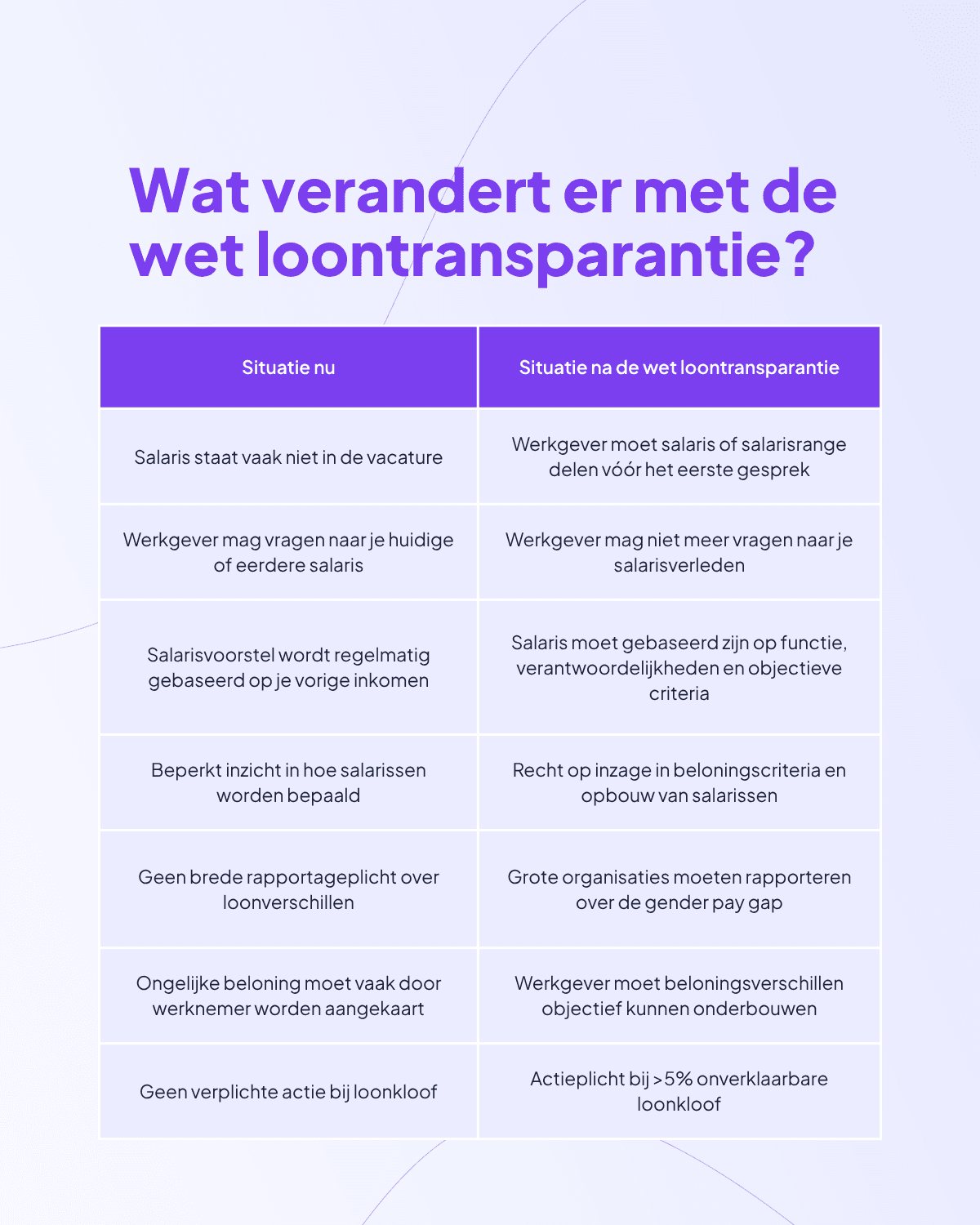
Overview: what applies now and what changes with the pay transparency law?
An at-a-glance overview of the key changes for you as an applicant.
Frequently asked questions about the pay transparency act
Does the pay transparency law also apply to small businesses?
Yes, the basic rules regarding salary information and the prohibition on asking about salary history apply in principle to all employers. The extensive reporting obligations regarding the gender pay gap primarily apply to larger organizations.
Is an employer still allowed to negotiate about salary?
Yes. Negotiation remains allowed. The difference is that the offer may no longer be based on your previous salary, but on the position and objective criteria such as experience and responsibilities.
What if an employer doesn't list a salary range?
After the law is introduced, an employer must share salary information before the first interview. If this does not happen, the employer is in violation of the new rules. As a candidate, you have the right to ask for this.
Does the law also apply to temporary contracts?
The directive is primarily aimed at salaried employees. Different legal frameworks apply to the self-employed. The transparency obligations regarding salary and reporting are mainly intended for employment relationships within organizations.
Does the Pay Transparency Act also apply to self-employed professionals?
The directive is primarily aimed at salaried employees. Different legal frameworks apply to the self-employed. The transparency obligations regarding salary and reporting are mainly intended for employment relationships within organizations.